Morgan Stanley
Project Details
As we began the pivotal redirection and waning of legacy applications at an enterprise level, we knew our payment portal would be key for the full adoption and satisfaction of our application. Current users found the process to collect payments to be confusing and arduous when handling a member over the phone. Processes were ill-planned and executed.

The Plan
Our objective with the new payments portal was to create a system that could be readily adopted by current and new phone advocates, then later retail center users. The product would have to meet both legal and business requirements but also user needs so they can assist members in a timely and enjoyable way.
-
Remove the need for referring to outdated paper scripts to verify with members
-
Remove the need for manual calculations of member invoice totals and balances
-
Develop safe reception of member payments through multiple methods
-
Consolidate similar user flows that cause confusion
-
Integrate new technology for the business with customer centric user flows
THE ROLES
-
UX Research
-
UX Design
-
Product Strategy
-
UI Design & Prototyping
-
Visual Design
-
Wireframes
START SMART
When beginning the payments portal initiative, we ensured we began our research on how to improve the experience and design with the user. I went through weeks of iterative testing with multiple users throughout the company to study the habits and needs to do their jobs. Through each phase, I developed an iterative design of prototypes with my findings.
LEARNING USERS
I facilitated one on one interviews with actual advocates from various levels of the enterprise to ensure all facets of users were addressed and studied. Targeting those who had key roles in the success or failure of the product would allow their voices to be heard proactively rather than reactively.
-
How do you complete a payment?
-
How do you currently create payment methods?
-
What key pain points do you find in the systems you use to do your job?
I found from my interviews that users were bothered by the nuisances that caused downtime and drag in their productivity on calls. There were major routines in place that hurt advocates AHT (Average Handle Times).
DEFINE REQUIREMENTS
After weeks of conversing with advocates on what a successful product would look like for them, it was time to sit with the business to ensure their requirements were aligned with our findings. We started conversations on what the business requirements were and worked with stakeholders and leadership to lay out a plan to move forward.

DRIVING IDEAS
Our multiple phases of prototyping and tests with our users made developing a viable product that much easier. I took the key components necessary to address business requirements and applied them to the findings of multiple tests with users.
As these concepts were fleshed out into high fidelity prototypes, I presented and shared our research and results with stakeholders and business to get each concept signed off on.
FINAL SOLUTION
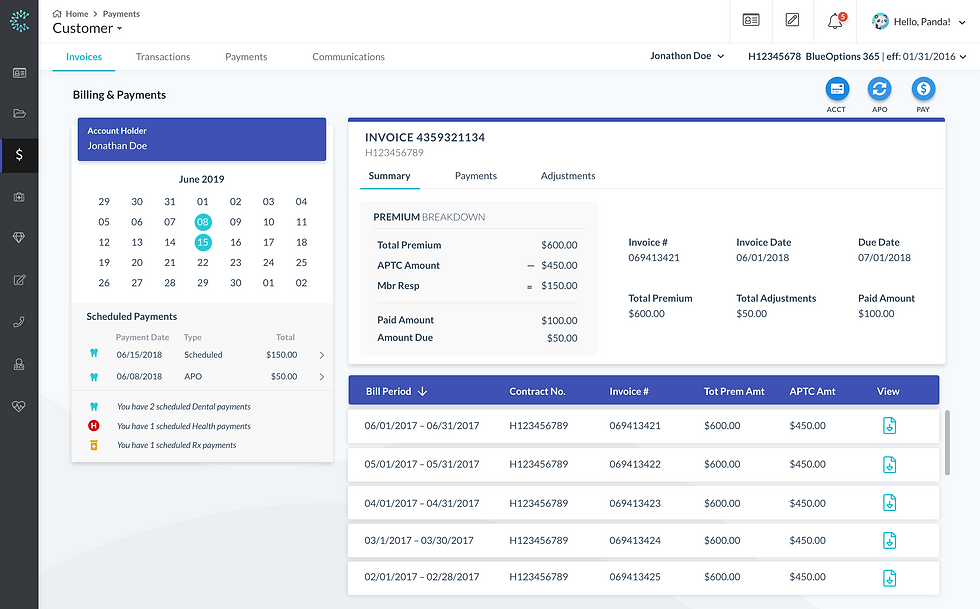
After the testing and iterations of prototypes, we came to a final solution that would wield the different applications needed to complete various user flows.
Within one product, advocates could now create payment methods and pay for multiple products through one page. In one view, advocates would be able to move a member through the entirety of their questions.
-
Create Payment Methods
-
Draft Automatic and Scheduled Payments
-
View Invoices and other payment documents
-
Research past payments and communications
-
Quickly view status and balance of account
FINAL TAKEAWAY
There were quite a few takeaways as we wrapped up the conceptualization of Customer Connect Payments.
-
Sometimes the business and the user may not agree on what is necessary to complete a job or task. In that event, it would be beneficial to err on the side of caution and create a solution that satisfies the users' needs while still being within range of the businesses budget.
-
Assumptions can leave vital information unseen or heard in the process of creating a new product. Take the time to attend to every detail.
-
It is important to truly study the habits of your user. If you are finding that some users complete different tasks than others, then recalibrate and create new test scenarios to accommodate their needs as well.